

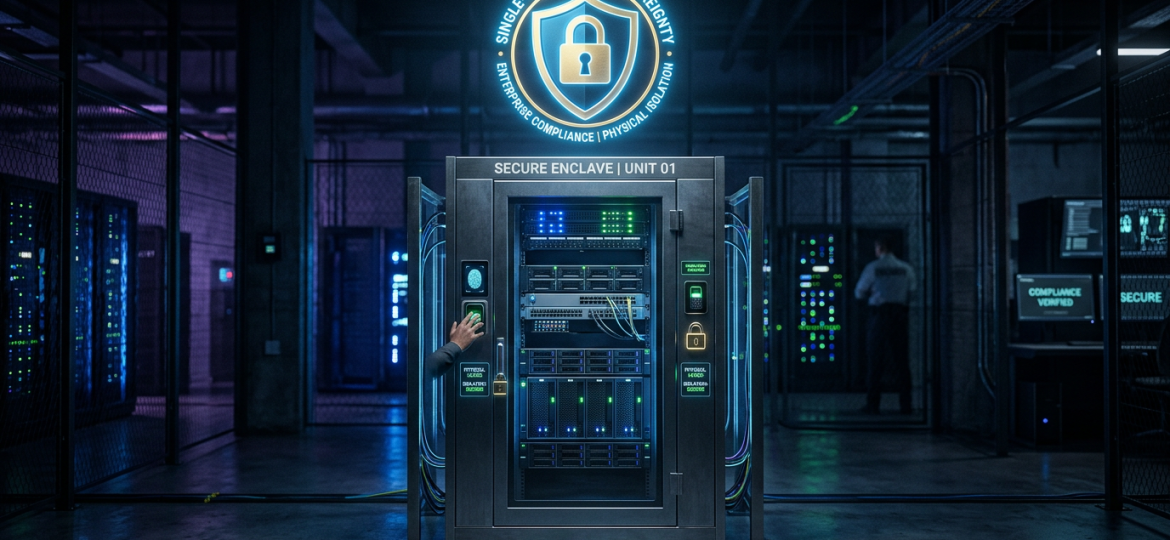
Quick Answer: Multi-tenant public clouds rely on software-defined boundaries (hypervisors) to separate your data from other companies sharing the same physical server. Single-tenant bare metal guarantees physical isolation, eliminating hypervisor vulnerabilities and massively simplifying compliance audits (SOC2, HIPAA, GDPR) for sensitive workloads.
As regulatory frameworks around data privacy (GDPR, HIPAA, SOC2) become more stringent, Mid-Market CIOs are under immense pressure to guarantee data sovereignty. We are told that the public cloud is the safest place to store sensitive data because of the massive security teams employed by hyperscalers.
But we need to talk about the inherent risks of multi-tenant cloud architectures, and why single-tenant bare metal (like our Hybrid Core setups) is quietly becoming the compliance superpower for enterprise IT.
Why is multi-tenant cloud a compliance risk?
When you provision a virtual machine on a public cloud, you are renting a slice of a physical server. You are sharing a hypervisor, a CPU, and memory buses with potentially dozens of other companies.
Your data sovereignty in this environment relies entirely on software-defined boundaries. The hypervisor is the only thing preventing “Company B” from reading the memory state of your application.
History has shown us that hypervisors are not infallible. Hardware-level vulnerabilities like Spectre, Meltdown, and more recent side-channel attacks exploit the shared architecture of modern CPUs. A single CVE in the hypervisor layer means your software-defined isolation vanishes. For healthcare, finance, or government contractors, this is an unnecessary gamble.
How does single-tenant Bare Metal guarantee physical isolation?
With a dedicated private cloud on independent hardware like Hetzner, the security paradigm shifts from software isolation to physical isolation.
| Feature | Multi-Tenant Cloud (AWS/Azure) | Single-Tenant Bare Metal |
|---|---|---|
| Hardware Ownership | Shared with dozens of unknown companies | 100% Dedicated to your organization |
| Isolation Layer | Software (Hypervisor) | Physical (Air-gapped hardware) |
| Vulnerability Risk | Susceptible to side-channel/neighbor attacks | Immune to noisy/malicious neighbors |
| Compliance Proof | Complex VPCs & third-party whitepapers | Physical machine ownership |
When you lease a dedicated server:
1. You own the entire physical machine.
2. There are no “noisy neighbors” sharing your CPU cache.
3. You have clear, undeniable hardware-level isolation to demonstrate to your auditors.
If an attacker wants to perform a side-channel attack on your CPU, they would first have to compromise your specific network perimeter and gain access to your specific physical machine. They cannot simply spin up a VM on the same hardware and wait for a hypervisor flaw.
What do auditors look for in data isolation?
During a SOC2 or ISO 27001 audit, demonstrating data isolation in a multi-tenant cloud often requires pointing to complex IAM roles, VPC configurations, and third-party vendor whitepapers.
With bare metal, the conversation is significantly shorter. “We own the physical servers. The drives are encrypted at rest. No other tenant has access to this hardware.”
Auditors love physical boundaries. It simplifies risk assessments and drastically reduces the scope of your compliance audits.
Conclusion
Data sovereignty is not just about where the data center is geographically located; it is about who is sitting on the server next to you. Stop treating data isolation like an afterthought. By moving sensitive compute workloads to single-tenant bare metal, you eliminate an entire class of hypervisor vulnerabilities and sleep better at night knowing your data sits on NVMe drives that ONLY your team can access.
Reclaim your proprietary data. Deploy Private AI.
Stop sending your proprietary IP to external APIs and managed SaaS. We deploy high-throughput inference and stateful agents directly onto your own Bare-Metal or VPC infrastructure. Execute AI workloads with zero API taxes, zero hyperscaler lock-in, and absolute control over your data.
discovery Zoom. We’ll review your AI workloads, data flows, and current cloud setup, then give you a clear Go / No-Go recommendation. If private inference, agent runtimes, or managed data services make sense for your architecture, we’ll show you the next step. If not, we’ll tell you directly.
Interested? Contact us.
Check out our RSS Feed to keep up with the cloud repatriation news