

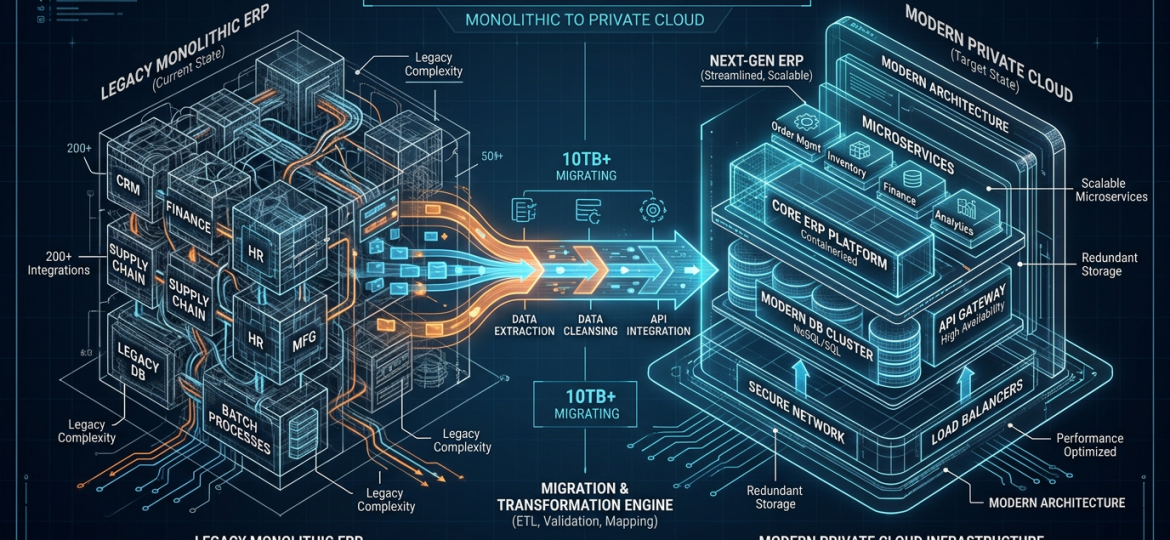
Quick Answer: Migrating a static, monolithic ERP system from AWS to a dedicated private cloud can reduce infrastructure costs by up to 65%. By eliminating idle compute waste, neutralizing AWS egress fees, and avoiding provisioned IOPS premiums, mid-market organizations can lock in a predictable, high-performance IT budget.
The Scenario
Let’s look at a common scenario we model for Mid-Market CIOs: a logistics company whose AWS bill has become the fastest-growing expense in their organization.
Imagine they are running a monolithic ERP system supporting 10,000 concurrent users globally. Because the system is monolithic, it wasn’t designed for horizontal auto-scaling. To handle peak load times, they must provision massive, always-on EC2 instances (like m5.12xlarge).
In this common architecture, an average monthly AWS bill can easily balloon to $15,000. For a Mid-Market CIO trying to lock in a fixed-cost IT budget, this unpredictable, escalating OpEx is unacceptable.
What are the financial inefficiencies of a monolithic ERP on AWS?
When we model this type of infrastructure, the financial inefficiencies become stark:
- Idle Compute Waste: Because the ERP can’t auto-scale effectively, they pay for peak capacity 24/7. Even if average CPU utilization is only 18%, they burn thousands of dollars a month on idle compute.
- The Egress Tax: ERPs generate massive data exports. It is common to see companies paying over $3,000 a month just in AWS data transfer fees (egress) to let their own employees download reports.
- Over-provisioned IOPS: They pay a premium for provisioned IOPS on their EBS volumes, a cost that scales aggressively under load.
What is the proposed Hybrid Core solution?
To solve this, we model a migration of the ERP’s compute layer to a dedicated private cloud utilizing The Hybrid Core on Hetzner bare metal hardware.
The Target Architecture:
| Component | Specification | Benefit |
|---|---|---|
| Compute | 3x Dedicated AMD EPYC Servers (256GB RAM, 3.4GHz) | Sustained high clock speeds |
| Storage | 4x 2TB NVMe Drives in RAID 10 per server | Massive, unmetered IOPS |
| Network | Unmetered 10Gbps uplinks | Zero data transfer (egress) fees |
The migration strategy involves replicating the database to the new bare-metal cluster via a secure WireGuard VPN tunnel, syncing the application state, and updating DNS records during a low-traffic maintenance window.
What are the modeled results of migrating to Private Cloud?
When mapped out, the financial and performance impacts of this migration are dramatic.
- Performance Boost: By moving from shared virtual CPUs to dedicated 3.4GHz AMD EPYC cores, report generation times typically decrease significantly. The local NVMe drives provide exponentially faster read/write speeds than provisioned AWS EBS volumes over a network.
- Zero Egress Fees: Because Hetzner provides unmetered bandwidth, the typical $3,000/month egress tax is completely eliminated.
- Financial Predictability: The infrastructure bill drops from a highly variable $15,000/month to a flat, predictable $3,500/month.
In this model, that represents a savings of over $130,000 annually.
More importantly, it allows a CIO to finally present a fixed-cost IT budget to the CFO. It eliminates the variable risk factor of public cloud billing without sacrificing performance or stability.
If you are running steady-state enterprise workloads on the public cloud, you are likely overpaying. Let’s look at the math for your infrastructure together.
Reclaim your proprietary data. Deploy Private AI.
Stop sending your proprietary IP to external APIs and managed SaaS. We deploy high-throughput inference and stateful agents directly onto your own Bare-Metal or VPC infrastructure. Execute AI workloads with zero API taxes, zero hyperscaler lock-in, and absolute control over your data.
discovery Zoom. We’ll review your AI workloads, data flows, and current cloud setup, then give you a clear Go / No-Go recommendation. If private inference, agent runtimes, or managed data services make sense for your architecture, we’ll show you the next step. If not, we’ll tell you directly.
Interested? Contact us.
Check out our RSS Feed to keep up with the cloud repatriation news